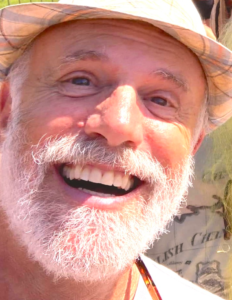
I discovered The Reduced Shakespeare Company by watching them myself from a hay bale at The Renaissance Pleasure Faire in Agoura, California. Years later I got to know Daniel Singer personally. We both sang together in The Briton Ensemble as part of a madrigal group led by director James Briton Hendricks. The group performed at Renaissance Faires, The Great Dickens Christmas Fair in San Francisco, at seasonal concerts, and special events. We have been friends for more than 20 years. Despite our years of friendship, I’ve never asked him for details about the history of the RSC until now. I’m grateful that he consented to do this interview.
The following interview has been edited for clarity.
Overview
It started with a damp hay bale and a wooden stage. A teenage Daniel Singer was in the audience at the Renaissance Pleasure Faire in Northern California, listening to an actor perform Shakespeare under the open sky. He didn’t know yet what to do with what he was feeling. Over time he figured it out.
During the next few years Daniel continued attending The Renaissance Pleasure Faire in the Fall Season. He joyfully immersed himself in the magical world of a re-imagined theatrical Elizabethan England. He crossed from observer to participant, eventually becoming part of the show as a stage manager at eighteen.
When he graduated from high school he was determined to become a classical actor. Daniel felt he needed to ground himself with professional training. He had a burning ambition to learn in Shakespeare’s country of birth. He couldn’t explain why at the time, but only England would suffice!
After multiple successful auditions, he chose a two-year program outside of London that suited his purposes and budget. He then applied his passion and devoted himself to rigorous study and performing. On the weekends he buzzed to London where his student ID allowed discount tickets to see as many professional plays as he had time for. He kept copious notes detailing what he learned from watching professional productions. After two years he returned home with a head full of knowledge and experience, plus an adapted version of Hamlet in his suitcase.
Daniel was immediately welcomed back to the RP Faire in Black Point Forest CA, near his home. He offered his script for consideration as an official stage show. He was delighted that it was green lit, and he began casting the show that evolved into The Reduced Shakespeare Company. After the initial season, the group coalesced around Daniel Singer, Adam Long, and Jess Winfield. The RSC proceeded to charm crowds at the Faire for several years before branching out to conquer the world.
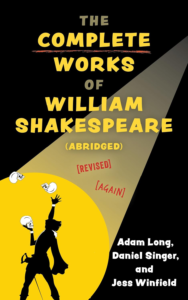
As all three members were excellent actors, improvisors, and writers, they went on to craft The Complete Works of William Shakespeare (Abridged) as a theatre length entertainment. It was performed at the Edinburgh Fringe Festival, toured for two years, had a residency in London, and was released as a published work. Quite an accomplishment, I must say!
After Daniel stepped away in 1989 and the other founding members eventually followed, the rights and the name were carefully sorted out and passed on. You can find the legacy RSC at thereducedshakespearecompany.com
The Interview
When you were a teenager at the Faire, what were you actually watching?
I’m pretty sure somebody was doing a half-hour Hamlet on one of the stages. I don’t know who. I just remember sitting on a damp hay bale on a foggy morning, hearing little quotes, thinking: this is a great opportunity. Not a full play. Not two or three hours of Shakespeare. Just this little schmear of Shakespeare. That stuck with me.
That experience clearly made an impression. What did you do with it?
I started working at the Faire as a performer and stage manager at eighteen. But I knew I wanted to train properly. I was an Anglophile. I had a burning need to go to Shakespeare’s country of birth and absorb it from the inside. I auditioned for every drama school in England that would have me. RADA said they weren’t accepting Americans that year. I ended up at what’s now the Guildford School of Acting, about thirty miles south of London. Classes nine to three every morning, rehearsal until five, building our own sets on top of that. Forty hours a week. I did All’s Well That Ends Well there. On weekends I used my student ID to see every professional production I could get to. I came home with received pronunciation, a notebook full of observations, and an adapted Hamlet in my bag.
What happened when you got back to California?
The Faire welcomed me back as a performer and director. I asked who was doing Shakespeare there. Nobody was. So I pitched them a four-person, half-hour Hamlet I already had a script for. They said yes immediately, gave me costumes and props, and I held open auditions. That’s where I met Jess Winfield and Adam Long. 1981. That was our birth.
You mentioned the four-person Hamlet was just the beginning. How did the group take shape from there?
We did Hamlet for both the Northern and Southern Faire runs that first year. Our fourth member, Barbara Reinardson, was playing Ophelia and Gertrude. Third weekend, she stepped in a hole during a parade and tore ligaments in her leg, ended up in a giant plaster cast. We needed a replacement fast. Jess said: Adam can do it. Adam will be very funny, and it’s in the tradition of boys playing the women’s parts. He was right. Adam was so funny that people started asking what we were going to do when Barbara came back. Barbara solved that herself. She said like hell you’re replacing me, I’ll do the show in a plaster cast. So Adam and Barbara alternated in the role for the rest of the fair.
What happened after that first season?
Jess needed to step away to finish his degree at UC Berkeley. So Adam and I were left thinking: what do we do now? Adam had an idea for a two-man Romeo and Juliet. He wrote the script. It’s a really, really funny script. We started doing it in 1983, and that’s when everything started to shift.
How so?
The original Hamlet was a serious attempt at adaptation. We wanted to tell the story within the constraints of the Faire: no proscenium, daytime, outdoors, half an hour. But you have parades going by. Food vendors calling out. Ambient noise from every direction. The audience isn’t sitting in a darkened theater with nowhere else to look. They’re standing in the sun eating turkey legs, and they can walk away at any moment. So you learn very quickly that your job is not to tell them the story of Romeo and Juliet. Your job is to keep them there.
With Adam, it became something else entirely. We were playing directly out to the audience, no fourth wall, the way a stand-up comic works a room. I was setting up gags like a straight man and Adam was delivering these hilarious punchlines, verbal and physical. We became a comedy team. More Marx Brothers than Shakespeare. More Abbott and Costello than the Globe Theatre. And as our act improved, we started getting these huge responses from audiences, and I realized it was much more worthwhile to deliver the fun and the laughter than to convince anyone of the story of the star-crossed lovers.
When did Jess come back into it?
Adam and I did Romeo and Juliet through ’83 and ’84. When Jess finished college and rejoined us, we put Hamlet back in the repertoire alongside it. By then we had a new style, a new approach. We’d figured out how to whip an audience into a frenzy by the end of a show, doing encores, doing Hamlet backwards in under two minutes. We weren’t just performers anymore. We were writers and directors too, and after every show we’d be backstage talking through what worked and what didn’t. The juggler friends we had taught us something practical: the better your show, the more the audience digs into their pockets when you pass the hat. So the incentive to make it funnier was very direct.
Where did the name Reduced Shakespeare Company come from?
I came in one morning before the Faire opened with a list of troupe names. Reduced Shakespeare Company was at the top. I was a devoted fan of the Royal Shakespeare Company. I’d seen everything they did while I was in London, including their eight-hour Nicholas Nickleby, which I sat through without moving. I thought they were the coolest company in the world. So I thought: what if we used the same initials as a kind of homage?
Years later, when the RSC got criticized for feeling cold and institutional at the Barbican, some press suggested they look to “that little upstart RSC down at the Criterion” for inspiration. We were embarrassed. We were also thrilled.
How did the Edinburgh Fringe come about?
Doing all thirty-seven plays at the Edinburgh Fringe Festival just seemed like a great idea. We booked the theater in ’86 going into ’87 and honestly didn’t stop to think too hard about what that meant. The venue was ours for two hours total. Setup, teardown, and an opening act ate most of it. We had about an hour for the show itself.
We figured there’d be a lot of cheating involved. Combine the comedies into one comedy. Turn the histories into a football game. Hit the tragedies as fast as possible. We ended up rewriting chunks of it stuck in a hotel after missing our connecting flight to Scotland. Got there, did the show, it was a hit. Got great press. Then went home thinking: I guess it’s back to the Faire, passing the hat. We had no idea what would come of it.
What did come of it?
We performed it anywhere we could: at Venice Beach, on Catalina Island, private parties. Comedy festivals, Shakespeare festivals, college one-nighters. Gradually we became a touring act. Then London. And when you’re a hit in London, you become globally recognized. We toured with the original cast: me, Jess, and Adam, from ’87 to ’89.
The tour ended in 1989. What happened after the tour?
I had an opportunity to join Disney as an Imagineer, designing theme park rides. Something I’d always wanted to do. I felt like I’d gotten what I needed out of the company, and I kind of felt like I needed to prove the show could go on without me. It’s like a rock band: members leave, the music continues. They held auditions, found Reed Martin, and the company has kept going ever since.
So how did you handle leaving without losing what you’d created? How was that process handled?
The Reduced Shakespeare Company was something I was handing over entirely. Take it, it’s yours, I want no further participation. But The Complete Works of William Shakespeare (Abridged) would always be credited to its three original authors: me, Jess, and Adam. Those are two different things. Took years to enforce. Posters and programs kept conflating them and we’d have to write letters.
And the London run that followed?
The show opened in London in 1995, first at the Arts Theatre, then moved to the Criterion Theatre in Piccadilly Circus, where it ran nine years, from ’95 to 2004. The marquee had Shakespeare in Groucho glasses smoking a cigar. Right there in Piccadilly Circus for nearly a decade.
At some point it became available for licensing, then for translation. About thirty languages now. Shakespeare is global. Shakespeare is eternal. There’s a magic ingredient in this material that makes it work even when it’s wrapped inside what is basically a silly vaudeville show.
Were there any unexpected audiences that found it?
Educators started using it in classrooms. I’ve had so many teachers come up and say: thank you, we use this to get kids into Shakespeare. Nothing could have been further from our minds when we wrote it. That’s a win we didn’t plan for. Shakespeare did that. We just got out of the way.
Didn’t schools run into a problem using it in competition?
Some students wanted to perform scenes in a drama competition and were told they couldn’t. Technically it isn’t a play. It’s a vaudeville show. The performers play versions of themselves, not characters. Shakespeare festivals turned us down early on too, calling it a parody.
Now there isn’t a Shakespeare festival in America that hasn’t programmed Complete Works (Abridged). Schools use it constantly. And the format seems to have inspired others: Complete Star Wars (Abridged), Complete Harry Potter (Abridged). We take a little credit for that genre.
Of all the productions you’ve seen since you left, which one surprised you most?
The first all-female version I saw. I had a hard time picturing it before I actually sat in the audience. I was blown away by how naturally the material fit them. At intermission I was in the lobby and overheard two women looking at cast photos on the wall. One said to the other: “Oh, I guess they didn’t write this themselves.”
They’d adapted it so completely to who they were that the audience had no idea it had been written by someone else. That opened something up for me. The show belongs to whoever performs it.
Where has your career gone since you left the Reduced Shakespeare Company as an active member?
I worked at Disney for twelve years as an Imagineer, retired at forty. Started thinking of myself more as a writer. Spent time learning the craft. In my fifties I wrote a two-hander called A Perfect Likeness: Carroll Photographs Dickens, imagining a conversation between Lewis Carroll and Charles Dickens. It found its legs. At least six productions, and it’s published. That gave me confidence to go back to a backlog of other ideas.
Most recently I wrote Louisa at Fruitlands, about a ten-year-old Louisa May Alcott whose family joined a transcendentalist farm commune with connections to Emerson and Thoreau. It’s been in a strong run at a community theater in Northern California.
Any closing thought?
Go see live theater. We can watch filmed entertainment at home forever, but seeing something live is a fundamentally different experience. And it doesn’t have to be expensive. Twenty-five dollar tickets exist. You can afford twenty-five dollars. Go see a play!
For more on The Complete Works of William Shakespeare (Abridged) and the legacy Reduced Shakespeare Company, visit thereducedshakespearecompany.com